Oh Gosh! 變成了一位software engineer。
工作忙碌,能幫忙看SOP時間的稀少
ps. 如果有連結壞掉了,可以聯絡我,我會盡快修復。
工作忙碌,能幫忙看SOP時間的稀少
ps. 如果有連結壞掉了,可以聯絡我,我會盡快修復。
- Mar 01 Sun 2009 16:16
-
3/02 Prions Involved in Some Alzheimer's
- Mar 01 Sun 2009 13:20
-
2/28 Sword Swallowers Awareness Day
- Sep 08 Mon 2008 19:38
-
8/22 Tipsy Sports Fans Easily Buy More Booze
- Aug 27 Wed 2008 12:37
-
8/27 -- Still Fighting the Plague
Still Fighting the Plague
The plague is most famous for killing tens of millions of people all over Europe in the 1300s. Plague is caused by the bacteria Yersinia pestis. And the disease still exists in pockets around the world. In fact, because it can be transmitted through the air, the government considers the plague a Category A bioterrorism agent and a serious potential threat.
Scientists from the University of Idaho have published a way to fight back at the plague in the journal Microbiology. Bacteria that cause the disease get past our defenses by dampening the immune system and actually preventing it from responding. But researchers have developed molecules that mimic a lipid on the bacterial surface. These molecules make the immune response spring back to life.
Scientists tested a nasal spray with two such molecules on mice infected with the plague. The spray enlivened the animals' immune systems and made antibiotics much more effective. The spray and antibiotic combination helped more mice live through the plague compared with a control group. Despite this advance, one should still avoid Yersinia pestis like, well, the plague.
大意:
科學家發現可以更有效對抗瘟疫的抗體,可防止恐怖主義的生物攻擊
- Aug 26 Tue 2008 07:59
-
8/26--Cows Tend to Face North-South

大意:科學家利用google earth的衛星照片,發現牛傾向指向南北方
Cows Tend to Face North-South
Don't be fooled by those big bovine eyes and the mouth slowly chewing cud—cows have a magnetic personality. At least that's the claim made by German researchers in the August 26th issue of the Proceedings of the National Academy of Sciences. Using Google Earth images, the scientists looked down on over 8,000 cattle around the world. And, when grazing or resting, cows tended to face either magnetic north or south.
The researchers combined field observations with the satellite data and discovered that herds of both deer and cattle tend to align themselves north-south. Factors like wind and the angle of the sun had little bearing on how the animals stood. More often than not, like needles of a compass, heads swiveled northward. While it's been known that birds, bees and fish use the earth's magnetic fields for orientation, this study is the first to point to a magnetic sense in large mammals. The scientists speculate that this behavior may allow the animals to stay spatially oriented. In case danger lurks and a cow needs to make any sudden…moos.
- Aug 24 Sun 2008 16:08
-
8/20 --Fruit Juices Block Some Drugs

Fruit Juices Block Some Drugs
You've no doubt heard that grapefruit juice can greatly increase the effects of some drugs. Even to a dangerous degree. Pharmacologist David Bailey made that discovery almost 20 years ago. A substance in the juice blocks an enzyme that breaks down the drugs. Now Bailey's back with a fresh finding—grapefruit juice, orange juice, apple juice and other fruit juices can also severely decrease the absorption of certain drugs. He announced this discovery August 19th at the national meeting of the American Chemical Society in Philadelphia.
Some of the drugs that have their dosages effectively decreased by various juices include medications that fight heart disease, infection and even the rejection of transplants. Key ingredients in the juices appear to block a molecule that carries drugs from the small intestine into the bloodstream. So a lot of the medication gets flushed out without ever reaching its target. Bailey says, "This is just the tip of the iceberg. I'm sure we'll find more and more drugs that are affected this way." So when taking medications, a sip of H2O is probably the way to go.
- Aug 24 Sun 2008 09:08
-
8/19--1918 Flu Antibodies Alive and Well

1918 Flu Antibodies Alive and Well
Some people never forget a face. Others never forget a flu. Even if they were infected more than 90 years ago. A team of American scientists studied 32 people who survived the 1918 flu epidemic. That virus, also called the Spanish flu, killed an estimated 20 to 100 million people worldwide.
Of course many more survived, and some are still around today. The scientists tracked them down and took a small sample of their blood. And they found that all 32 people they tested still had circulating antibodies that could recognize the 1918 flu strain. What's even more remarkable is that these immune molecules still work. Injecting the antibodies into mice protected the animals from experimental infection with the virus. The results were published online in the journal Nature on August 13th.
- Aug 16 Sat 2008 14:08
-
8/15 --Air Fresheners' Unlisted Ingredients

Air Fresheners' Unlisted Ingredients
Laundry detergents and air fresheners have long promised
to keep your house and clothes smelling sunshine fresh and rain shower clean.
But what they haven't said is what exactly you're sniffing
when you snuggle up in your just-washed sheets.
After hearing from people who said strong scents made them sick,
University of Washington researcher Anne Steinemann
scratched the surface and found almost a hundred chemicals
that weren't listed on the labels.
According to her report in the journal Environmental Impact Assessment Review,
plug-in air fresheners, scented sprays, dryer sheets and detergents
all contained a mixture of volatile organic compounds.
Since manufacturers aren't required to list their ingredients
for such consumer products,
the boxes only admitted to containing a "mixture of perfume oils."
But five out of the six products Steinemann tested emitted one or more
so-called hazardous air pollutants,
which are carcinogens determined to have no safe exposure level by the EPA.
While the study did not test for any human health risk from exposure to these chemicals,
Steinemenn says the next time the air in the house smells stale,
maybe you just open a window.
大意:
科學家發現在洗衣精、空氣清香劑中有許多成分為被標明
但而不能知道這些成分對人體有沒有害
- Aug 14 Thu 2008 11:08
-
8/14 --Bees Help Track Criminals
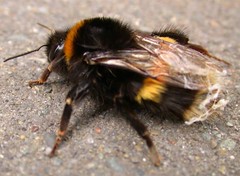
Bees Help Track Criminals
Unless you're talking about killer bees,
it's hard to imagine a situation
in which 「killers」 and 「bees」 would be related.
But it turns out that scientists are using the same mathematical model
to describe the behavior of both bumblebees and human serial killers.
- Aug 13 Wed 2008 10:08
-
8/13--Google-Style Rankings for Ecosystems
Google-Style Rankings for Ecosystems
Since so many species in a food web are interconnected,
the demise of a one can mean extinction for several others that depend on it for food.
Thanks to things like climate change and habitat destruction,
this "bottom-up extinction" has ecologists scrambling to save key species.
Stefano Allesino says they may just want to Google the problem.
Speaking on August 4th at the Ecological Society of America's annual conference,
Allesino outlined a new way to rank the species of an ecosystem.
Google uses a complicated algorithm to rank web pages that best match a query.
Basically, a single webpage ranks low,
but rises in importance if a handful of other pages link to it.
The highest ranked sites have thousands of these well-connected pages linked to them.
Inspired by this system, Allesino's formula gives importance to a species if it supplies food to another.
And, if that species serves as food for several organisms,
it climbs up the rankings.
Higher ranked species, says Allesino, should become the focus of conservation efforts.
And that means there's finally a perk to being the foundation of the food web.
perk n.【口】津貼;額外補貼 =perquisite
大意:
生物學家想傚法Google用來排名網站的方法
來排名生物在環境中的重要性
- Aug 12 Tue 2008 10:08
-
8/12 --Pepper Heat Battles Bugs
1

